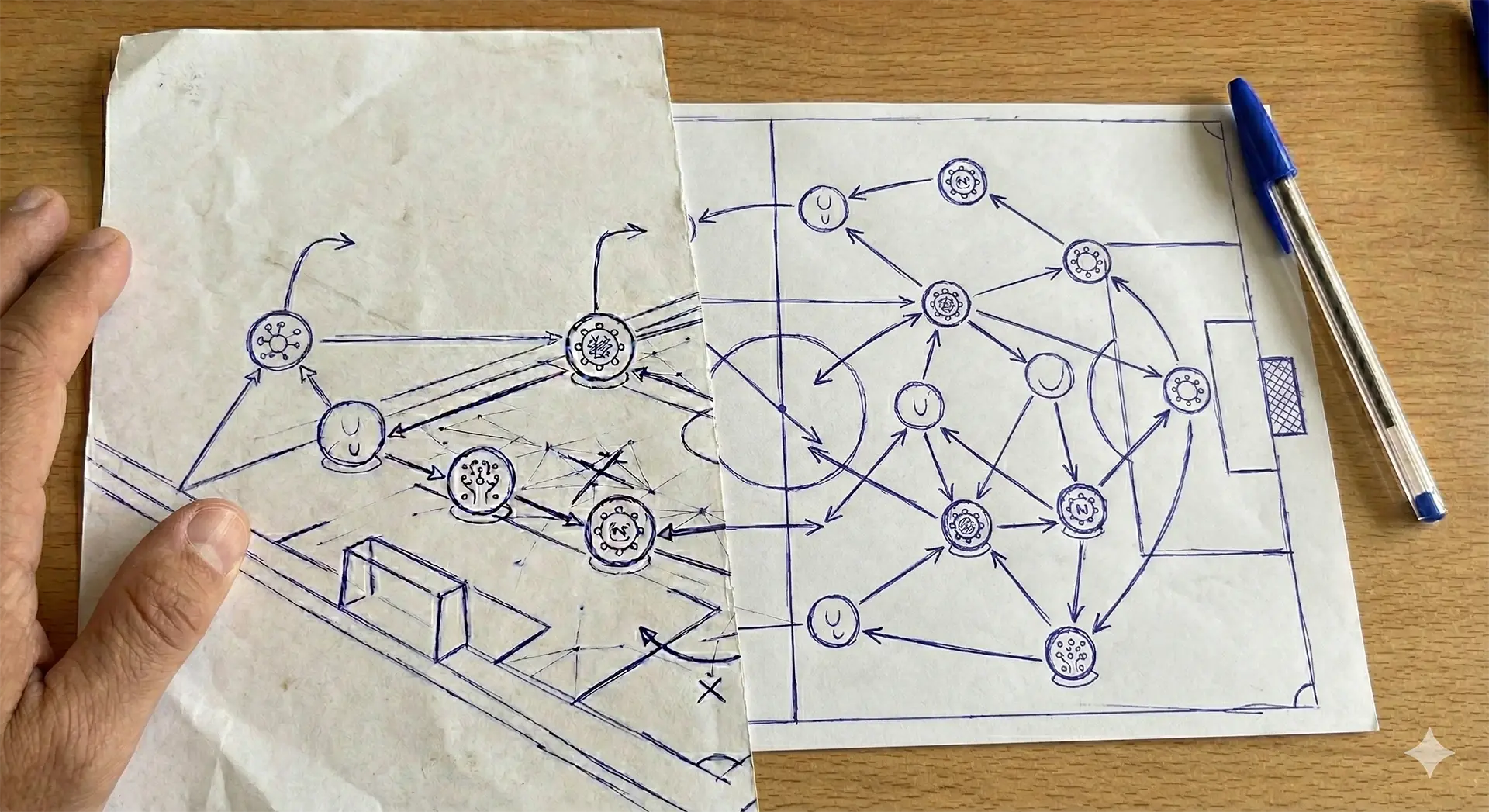
Most companies do with artificial intelligence what a struggling team does at the winter transfer window.
They spend heavily, bring in the star player who's supposed to change everything, and expect their league position to improve overnight. When results don't come, the player gets the blame: overhyped, arrived at the wrong time. But championships aren't won with a single talent. They're won by rethinking the playbook, changing how teammates (the star player included) move under pressure, and rebuilding trust when the system changes. Without that work, even world-class players don't deliver what's expected of them.
The same thing has happened with AI. The numbers confirm it: between May and July 2025, employee confidence in generative AI tools provided by their company fell by 31%. Confidence in agentic systems collapsed by 89%. And nearly half of employees did the most predictable thing in the world: they abandoned the official tools and started using personal LLMs (often free ones with significant privacy concerns) in secret, trusting ChatGPT more than their own organization's AI strategy3.
Why Those Who Redesign the Playbook Have a 3x Advantage
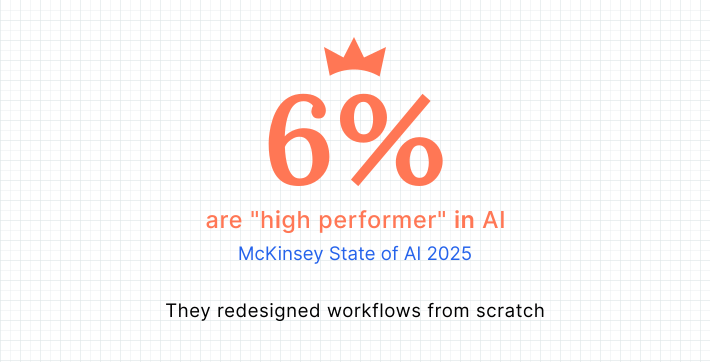
The McKinsey State of AI 2025 report captures the gap. Only 6% of surveyed organizations qualify as AI "high performers": companies generating at least 5% of EBIT from artificial intelligence and reporting tangible business value1. A very small elite out of nearly two thousand organizations across 105 countries.
What do they do differently? They didn't simply add AI to existing processes. They redesigned workflows from scratch at three times the frequency of everyone else. In sporting terms: they didn't plug the star player into an old system; they changed the system to get the most out of what the player does best.
Most organizations haven't done this. Only 21% have redesigned even a portion of their workflows. The rest have tried to compete with the old playbook built for a team that didn't include AI and then wondered why the results weren't changing.
But is workflow redesign really that decisive? McKinsey's data says yes: it's the factor with the strongest correlation in translating AI capabilities into measurable business impact. It's not an operational detail. It's the dividing line between an AI that remains an accessory and an AI that changes the rules of competition.
Augmentation or Synergy?
MIT Sloan research highlights the differences between teams that stall and those that improve2.
Augmentation is the equivalent of inserting a good player into an unchanged system. Performance improves compared to the team without them, but it hits a ceiling set by the system itself. It's easier to implement, less disruptive, and requires less upfront investment. It’s also why most organizations stop here. But this minimal-change approach comes at a cost: it leaves a significant portion of the potential on the table.
Synergy, on the other hand, occurs when human-AI collaboration exceeds the performance of either alone. Human and machine don't work independently — they complement each other. Getting there requires rethinking workflows and more significant changes, but the return is real, especially in creative tasks, where MIT's research found the most significant effects2.
Those who aim for synergy aren't optimizing this quarter's efficiency. They're building a structural advantage, redesigning how work is coordinated, not just which tool to use for a given task.
Trust is Trained, Not Installed
By mid-2025, something had started to crack. Confidence in enterprise generative AI in free fall, confidence in agentic systems practically wiped out. And from there, the predictable response: employees setting aside official tools their companies had invested millions in.
In any functioning team, trust is built through training. Players don't believe in a new system just because it's been billed as "revolutionary." They believe in it after the repetitions, the feedback, the shared wins. In too many companies, AI is introduced without those foundations.
But the data also shows what works: employees who received hands-on training report significantly higher levels of trust in their company's AI tools. And those who trust are far more willing to learn new skills and adapt, exactly the behavior needed to make transformation work3.
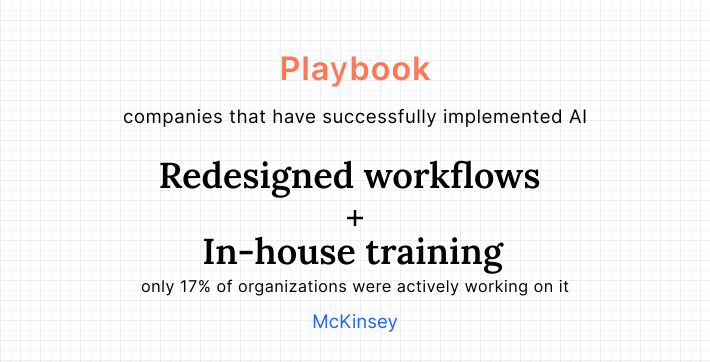
There is also a transparency problem. At the time of McKinsey's 2024 survey, only 17% of organizations were actively working on AI explainability, even though nearly half recognized it as one of their greatest risks4. What does this mean in practice? Understanding the "why" behind AI responses and outputs isn't a technical box to check. It allows people to make sense of those results and approach them critically. It allows them to get more out of the tools. Without that visibility, trust erodes and coordination breaks down.
What Makes the Difference
Organizations that see real impact from AI share a specific discipline. They redesign workflows to enable human-machine collaboration, rather than forcing AI into structures inherited from the past: they don't add a technology layer onto an unchanged process, they let the new capabilities change the way work gets done. They invest in training, not just implementation: hands-on learning and co-creation build trust in ways that no top-down mandate can replicate.
They don't take the easy road, and they don't shy away from difficult decisions.
Rebuild or Compete
The gap between the 6% of companies that succeed in implementing AI projects and everyone else doesn't come down to ambition or tools. It comes down to leadership's willingness to rethink processes1.
The companies best positioned to win aren't the ones that adopted AI first. They're the ones that rebuilt trust, rewrote the playbook, and created systems where people and artificial intelligence play well together. That 6% has already made their choice.
Fonti:
[1] McKinsey & Company, The State of AI in 2025: Agents, Innovation, and Transformation (Novembre 2025) — Survey on 1.993 organizations in 105 countries.
[2] MIT Sloan / Malone, Almaatouq, Vaccaro, "When humans and AI work best together — and when each is better alone", published in Nature Human Behaviour (2025) — Meta-analysis on 106 experiments.
[3] Harvard Business Review / Deloitte TrustID Index, "Workers Don't Trust AI. Here's How Companies Can Change That" (Novembre 2025) — Dati Deloitte TrustID, May-July 2025.
[4] McKinsey & Company, "Building AI Trust: The Key Role of Explainability" (2024).